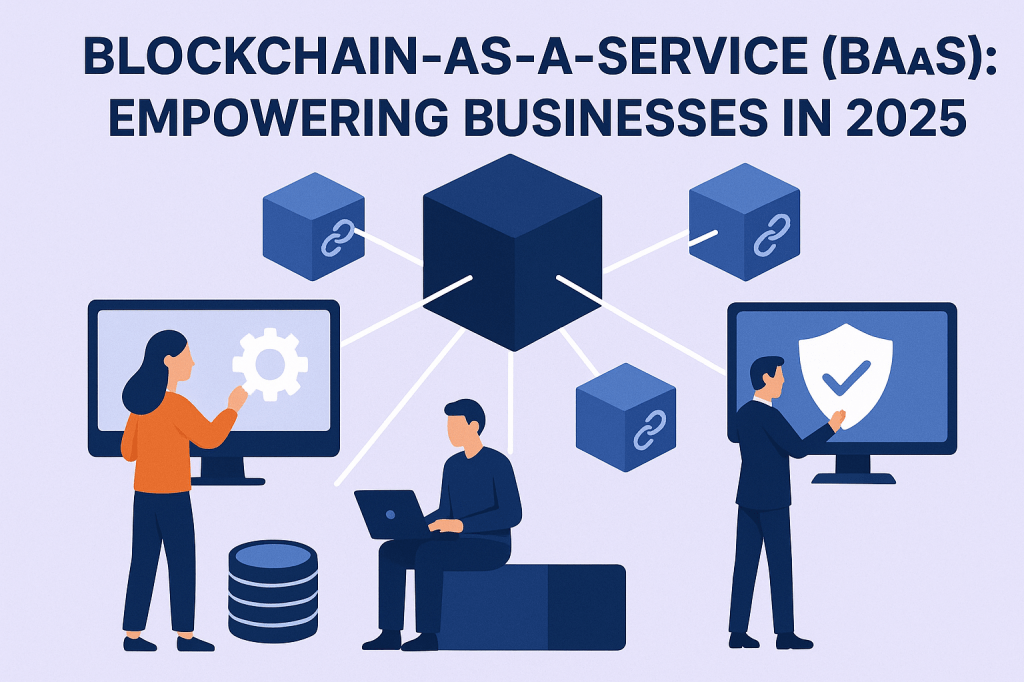
In 2025, Blockchain-as-a-Service (BaaS) is becoming one of the most important enablers of digital transformation across industries. What started as a niche concept is now playing a central role in how businesses build secure, transparent, and decentralized applications. Companies across sectors—from logistics to finance to healthcare—are no longer questioning whether blockchain can provide value. Instead, they are asking how quickly they can deploy blockchain solutions and who can help them do it efficiently. That’s where BaaS comes in.
BaaS allows companies to access blockchain infrastructure, platforms, and tools without having to manage the complex backend processes themselves. Just as cloud computing allowed businesses to rent servers rather than build data centers, BaaS offers organizations a managed environment to develop, host, and scale blockchain-based applications. This service model reduces the technical burden while unlocking the unique features of distributed ledgers—such as immutability, transparency, and automation through smart contracts.
Why Blockchain Matters for Business in 2025
Blockchain adoption is no longer limited to cryptocurrency. Businesses now use blockchain to verify supply chains, automate contract execution, protect intellectual property, trace financial transactions, and manage digital identity. In many cases, these applications don’t require public blockchains or complex crypto ecosystems. What they need is a secure, reliable, and customizable blockchain layer—exactly what BaaS provides.
The growing use of multi-party workflows in enterprise systems, increasing concerns about data security, and the push for real-time, verifiable information have all driven demand for blockchain. Yet, building and maintaining blockchain networks is resource-intensive. It requires infrastructure setup, node management, protocol upgrades, monitoring tools, and specialized developers. Most companies don’t have the in-house expertise to do all this from scratch, nor should they when viable service models exist.
By using Blockchain development services offered through BaaS platforms, businesses can focus on their core operations while integrating distributed ledger features into their products and services.
How BaaS Works in a Real Business Environment
BaaS platforms typically provide a suite of tools and managed services to support the full lifecycle of blockchain solutions. This includes provisioning nodes, configuring consensus mechanisms, managing smart contracts, monitoring network performance, and ensuring security compliance. The goal is to abstract away the complexity so businesses can launch applications without needing to build and maintain a blockchain backend.
In practice, a company might want to track the origin of its raw materials. Instead of setting up their own blockchain network, they subscribe to a BaaS platform that provides prebuilt supply chain templates. Through a web-based dashboard or API, they can create smart contracts to log events (e.g., shipment, arrival, inspection) and assign digital tokens representing assets. All participants in the supply chain have access to a shared ledger that is tamper-proof and time-stamped, improving trust and accountability.
Similarly, a fintech firm building a DeFi platform might use BaaS to test, deploy, and manage smart contracts across multiple blockchain networks, choosing from Ethereum-compatible chains or permissioned networks depending on compliance needs. These firms often rely on the best Blockchain Development Company to customize the solution and ensure it meets regulatory and performance standards.
Growth in BaaS Adoption Across Industries
Different sectors are leveraging BaaS in ways that align with their operational needs. In finance, BaaS is used to automate settlements, support tokenized assets, and comply with regulations through auditable transaction trails. In logistics, it’s helping track product movement with verifiable checkpoints that reduce fraud and inefficiencies. Healthcare providers are adopting blockchain to store patient records in a tamper-proof way, with access rights controlled via smart contracts.
Retailers are using BaaS to improve loyalty programs and digital coupons, issuing tokens that can be tracked and redeemed across partner networks. Intellectual property management platforms are using blockchain for timestamped proof-of-creation and automated royalty distribution. Even governments and public institutions are beginning to pilot blockchain-based voting systems and record keeping, often supported by commercial BaaS providers who understand both the technology and the need for public-sector accountability.
This cross-industry adoption shows that BaaS is not about hype—it’s about solving real problems using distributed systems. The companies offering Blockchain development services through BaaS are not just hosting platforms. They’re providing integration tools, consulting support, and security layers that ensure blockchain solutions are enterprise-grade and future-proof.
Advantages of BaaS for Business
One of the biggest advantages of Blockchain-as-a-Service is reduced time-to-market. With preconfigured environments, toolkits, and APIs, companies can move from concept to prototype in weeks, not months. The BaaS model also allows for predictable pricing, scalable infrastructure, and minimal overhead, which are crucial for startups and SMEs.
Security is another key factor. BaaS platforms usually come with built-in encryption, identity management, access controls, and audit trails. This reduces the risk of data breaches and unauthorized transactions, both of which can be difficult to detect and address in custom-built blockchain systems.
Operational resilience also improves with BaaS. Most providers include redundancy, backup services, and automatic updates, ensuring high availability and compliance with the latest protocol versions. This is especially important in regulated industries, where uptime, security audits, and legal traceability are required.
For businesses that require customization, the best Blockchain Development Company offers white-labeled BaaS platforms or builds bespoke solutions on top of major blockchain frameworks. This allows companies to maintain full control over their branding and customer experience while benefiting from the underlying technical foundation.
The Shift from Building to Integrating
There was a time when early adopters needed to build their blockchain architecture from scratch. This often required hiring blockchain engineers, managing infrastructure, writing smart contracts, testing consensus mechanisms, and worrying about network security. Many of these efforts failed—not because blockchain lacked value, but because the development process was too complex and costly for most businesses.
BaaS has changed that narrative. Today, businesses no longer have to be blockchain experts. They can integrate blockchain as easily as they integrate APIs or cloud storage. This doesn’t mean technical knowledge is unnecessary—it just means it’s more focused. The emphasis shifts to business logic, data flow, user experience, and compliance rather than protocol-level coding.
As a result, companies can allocate resources more efficiently. They focus on building the right customer solution and leverage BaaS partners for infrastructure and compliance. This collaborative model has made Blockchain development services more accessible and impactful than ever before.
Choosing the Right BaaS Partner
Not all BaaS providers are created equal. The choice of partner can significantly impact a project’s success. Key factors include the flexibility of the platform, support for multiple blockchain protocols, performance benchmarks, and ease of integration with existing enterprise systems. Equally important is the level of consulting and custom development support offered.
The best Blockchain Development Company will offer more than just hosting. They bring industry insights, real-world implementation experience, and a security-first mindset. Whether the goal is to build a supply chain platform, deploy NFTs, or create a digital identity system, the right partner ensures that blockchain is used effectively, not just implemented for the sake of trend.
As regulation tightens, especially around financial and personal data, compliance expertise also becomes a critical differentiator. Companies need partners who understand legal frameworks and can embed safeguards like KYC, AML, and data residency requirements into the blockchain solution.
BaaS in a Multi-Chain Future
As blockchain technology matures, the ecosystem is becoming increasingly multi-chain. Businesses don’t want to lock into a single protocol—they want flexibility. BaaS providers are responding by offering support for multiple chains, both public and private, and enabling cross-chain communication through bridges and interoperability tools.
This is particularly important for businesses operating in global markets or with diverse use cases. A single product might need to interact with Ethereum for smart contract logic, Polygon for transaction cost efficiency, and Hyperledger Fabric for enterprise-level data control. A good BaaS provider offers the infrastructure and middleware needed to connect these dots securely and reliably.
For developers and businesses, this multi-chain approach means they can build once and deploy across multiple ecosystems. This increases reach, improves user experience, and supports innovation at scale. It also enhances data portability and system resilience, reducing the risk of being locked into a single vendor or network.
The Road Ahead for BaaS
Looking forward, BaaS will continue to evolve as blockchain becomes more embedded in the digital fabric of business. We can expect to see tighter integration with cloud platforms, smarter developer tools, and the rise of blockchain-native applications that are indistinguishable from traditional web apps from the user’s perspective.
Artificial Intelligence is also expected to intersect with blockchain at the BaaS level, enabling dynamic contract execution, fraud detection, and predictive analytics within decentralized systems. Meanwhile, improvements in zero-knowledge proofs and secure multi-party computation will enhance privacy controls, allowing for secure data sharing without exposing raw information.
These developments will further increase demand for specialized Blockchain development services, especially for companies entering the blockchain space for the first time. The need for skilled partners who can build, secure, and maintain scalable blockchain applications will be essential as the technology becomes more deeply integrated into business operations.
Final Thoughts
Blockchain-as-a-Service in 2025 is not about speculation—it’s about execution. Businesses want solutions that work, scale, and comply with regulations. They’re not looking to become blockchain experts themselves. They want trusted partners, prebuilt tools, and clear value. BaaS delivers that model by making blockchain technology usable, manageable, and cost-effective for real-world applications.
With the support of experienced Blockchain development services, companies are launching blockchain products faster and with fewer risks. And by choosing the best Blockchain Development Company, they gain a competitive edge in industries where trust, transparency, and automation are becoming standard expectations—not optional upgrades.
The future of blockchain is service-driven, collaborative, and deeply practical. BaaS is not just a trend—it’s the infrastructure that’s powering the next wave of digital innovation across every industry.
 Blockchain Tech Blogs
Leave a comment